
Table of Contents
Editorials
Perspectives
Editorials
Memorial
Review Articles
Methodologic Perspectives
Patient Safety
Health Care Reform Vignette
Brain
- Utility of Proton MR Spectroscopy for Differentiating Typical and Atypical Primary Central Nervous System Lymphomas from Tumefactive Demyelinating Lesions
The utility of MRS in differentiating lymphoma from tumefactive demyelination was assessed in 44 patients with the former and 21 with the latter. A Cho/Cr over 2.58 and a high lipid/lactate peak were more common in lymphoma, therefore MRS may help in differentiating these 2 entities.
- Diffusion Measures Indicate Fight Exposure–Related Damage to Cerebral White Matter in Boxers and Mixed Martial Arts Fighters
Boxers and mixed martial arts athletes underwent brain DTI and the results were correlated with number of fights, knockouts, age, weight, and years of education. Total knockouts in boxers increased diffusivity in the corpus callosum, cingulate, pericalcarine, precuneus, and amygdala, while in martial arts athletes only the posterior cingulate was abnormal. Thus, fight exposure but not the number of fights can be used to predict microstructural brain damage.
- Use of FLAIR Imaging to Identify Onset Time of Cerebral Ischemia in a Canine Model
After an infarction-inducing procedure, 20 dogs were imaged at 3, 4, 5, 6, and 24 hours with FLAIR and DWI. A mismatch between the 2 sequences (positive DWI and negative FLAIR) was found to reliably predict the time of infarct onset. By 6 hours, 95% of dogs had FLAIR abnormalities and by 24 hours all did. However, at 3 hours only 15% of dogs showed positive FLAIR studies. These results could serve as guidelines to estimate the time of onset of ischemic events.
- Subcortical Cystic Lesions within the Anterior Superior Temporal Gyrus: A Newly Recognized Characteristic Location for Dilated Perivascular Spaces
Fifteen patients with unusual dilated perivascular spaces in the subcortical white matter of the anterior superior temporal gyrus were presented. In one, pathology showed gliosis and innumerable perivascular spaces. Findings that suggest cysts in this location were perivascular spaces include: lack of symptoms, proximity to the subarachnoid space, adjacent blood vessels, and stability over time.
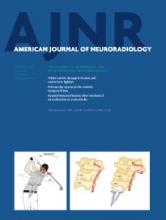
- Preferential Location for Arterial Dissection Presenting as Golf-Related Stroke
Seven patients with golf-related strokes were imaged and the literature was reviewed for similar cases, which generated a total 14 such occurrences. The most common time of symptom onset occurred during the golf swing and over one-half of patients damaged an extracranial vertebral artery with most dissections involving the right side. Of a total of 14 dissections, 7 patients had complete symptom resolution and returned to normal.
Interventional
Commentary
Head & Neck
Pediatrics
- Arterial Spin-Labeled Perfusion of Pediatric Brain Tumors
ASL was used to evaluate 54 children with recently diagnosed brain tumors using a pseudocontinuous technique and blood flow was calculated for all masses. Blood flow was higher in grade 3 and 4 tumors than in lower grade ones. Although ASL was unable to separate tumors by histology, perfusion was found to be higher in medulloblastomas than in pylocytic astrocytomas.